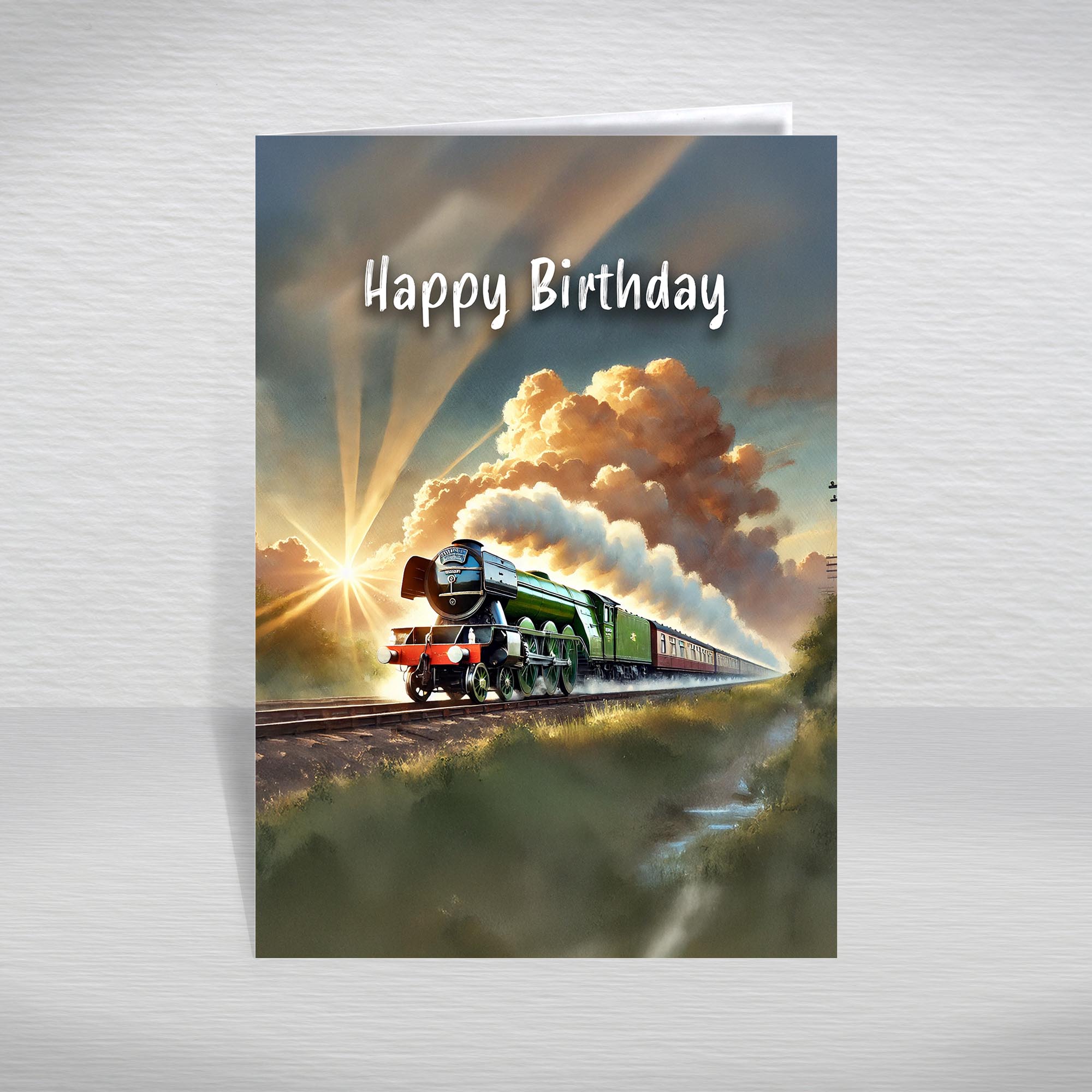
LNER Class A4
The LNER Class A4 is widely considered the most famous British steam locomotive class. Designed by Sir Nigel Gresley for the LNER's new Silver Jubilee high-speed service of 1935, thirty-five engines were built at Doncaster Works between 1935 and 1938. The class is most famous for No. 4468 Mallard, which on 3 July 1938 attained 126 mph (203 km/h) descending Stoke Bank south of Grantham, the world steam speed record, never since matched.
The A4 was Gresley's refinement of his earlier A1 and A3 Pacifics, with three innovations that together transformed performance. The internal-streamlined steam circuit (carefully proportioned passages between regulator and cylinders) reduced pressure losses; the boiler pressure was raised from 220 psi to 250 psi; and the wedge-shaped external streamlined casing, developed in wind-tunnel tests at the National Physical Laboratory at Teddington, reduced air resistance and lifted exhaust steam clear of the cab. The Kylchap double blastpipe and chimney was fitted to the prototype Mallard from new and progressively to the rest of the class from 1957 onwards.
The first four engines (the "Silver" batch, Nos 2509 Silver Link, 2510 Quicksilver, 2511 Silver King, 2512 Silver Fox) were completed at Doncaster in September 1935 in unique LNER silver-grey livery for the Silver Jubilee service launch. On the press preview run on 27 September 1935, Silver Link attained 112.5 mph between Arlesey and Hitchin, the first British speed run above 110 mph and the first commercial proof that streamlining delivered on its promise. Subsequent batches followed in 1936–1938 in the celebrated LNER garter blue with red coupling rods, totalling 35 engines named after birds, animals, and (latterly) British and overseas dignitaries.
British Railways inherited all 35 A4s in 1948. The class continued in front-line East Coast main-line service through the 1950s, the Flying Scotsman, Elizabethan, Talisman and Tees-Tyne Pullman were all A4-worked. The introduction of the Class 55 "Deltic" diesels from late 1961 progressively displaced them. From 1962 several A4s were transferred to BR Scottish Region for the Aberdeen–Glasgow services, where they had a final productive period before the last withdrawals in September 1966.
Six A4s are preserved, an exceptional 17% survival rate from a production of 35: Mallard (NRM York), Sir Nigel Gresley (main-line registered), Union of South Africa (Severn Valley Railway, main-line registered), Bittern (main-line registered, holding the post-preservation steam speed record at 92.8 mph), Dwight D. Eisenhower (returned from the United States in 2012, now at Locomotion Shildon) and Dominion of Canada (returned from Canada in 2012, now at Locomotion Shildon).
All six surviving A4s gathered together at the National Railway Museum for the 75th-anniversary "Great Gathering" of 3 July 2013, the only time the class has been reunited in preservation. The class's combination of engineering achievement, world record-breaking, and exceptional preservation profile makes it the most thoroughly-celebrated British steam locomotive design.
Design and development
By 1934 Sir Nigel Gresley had overseen 12 years of A1 and A3 Pacifics on the LNER's East Coast main line. The German Reichsbahn's 1932 high-speed diesel railcars (the Fliegende Hamburger and similar) had achieved 100 mph commercial speeds; Gresley believed that a refined A3 with internal-streamlined steam circuit, raised boiler pressure, and external streamlined casing could match those speeds with steam haulage and a heavier conventional train.
The LNER announced the Silver Jubilee service from London King's Cross to Newcastle in early 1935, with a non-stop scheduled time of four hours and a regular maximum speed of 100 mph. Gresley designed the A4 specifically for the service, sharing the A3's boiler general dimensions but with raised 250 psi pressure, internal-streamlined steam circuit, Kylchap double blastpipe (initially on the prototype Mallard only), and a wedge-shaped streamlined casing developed in wind-tunnel tests at the National Physical Laboratory at Teddington.
The first four engines (the "Silver" batch, Nos 2509 Silver Link, 2510 Quicksilver, 2511 Silver King, 2512 Silver Fox) were completed at Doncaster Works in September 1935 in time for the Silver Jubilee service launch on 30 September. They were finished in the unique LNER silver-grey livery. On the press preview run on 27 September 1935, Silver Link attained 112.5 mph between Arlesey and Hitchin, the first British speed run above 110 mph, and the first commercial proof that the streamlined design could deliver on its claims.
Production continued in successive batches: the Coronation batch (4462–4469) of 1936–1937 for the new Coronation service to Edinburgh; the Empire batch (4482–4498) of 1937 named after British Empire dominions; further batches through 1938 for the West Riding Limited and other duties. By 1938 thirty-five A4s had been built. The Kylchap double blastpipe, fitted only to Mallard from new, was found in service trials to give substantially better steaming and was progressively retrofitted to the rest of the class from 1957 onwards.
Service and withdrawals
The A4s were the LNER's flagship express engines for thirty years. The Silver Jubilee, Coronation, and West Riding Limited were all A4-worked services, regularly running at average speeds of 70–80 mph including stops. The class's most famous achievement came on 3 July 1938, when a special LWR Westinghouse brake test train hauled by Mallard descending Stoke Bank achieved 126 mph (203 km/h), the world steam speed record, taken from the German Reichsbahn DRG 05 Class which had achieved 124.5 mph in 1936.
The Second World War saw the streamlined services suspended; the A4s worked heavy general traffic in unlined wartime black. Side valances were removed from 1942 onwards to give shed staff easier access to the running gear. Post-war the streamlined services resumed (now the Capitals Limited and the Tees-Tyne Pullman) and the class returned to garter blue.
British Railways inherited all 35 A4s in 1948. The class continued in front-line East Coast main-line service through the 1950s, the Flying Scotsman, the Elizabethan (the post-war non-stop summer-only service), and the Talisman were all A4-worked. The introduction of the Deltic diesels from late 1961 progressively displaced them.
From 1962 several A4s were transferred to BR Scottish Region for the Aberdeen–Glasgow services, particularly the Grampian Express. Their reliability and three-cylinder smoothness suited them well to the gradient profile, and the Aberdeen-allocated A4s gave the class a final productive period before the end. The last A4s in BR service were withdrawn from Aberdeen Ferryhill in September 1966, by which date six examples had already been preserved.
Identification features
The most distinctive British steam locomotive outline of the 20th century. The wedge-shaped streamlined casing, developed in wind-tunnel tests at the National Physical Laboratory at Teddington, was specifically designed to reduce air resistance at high speeds and to lift exhaust steam clear of the cab, both demonstrably effective at the speeds for which the class was built. The class is named after birds, animals, and (later in the build sequence) British and overseas dignitaries, with brass nameplates carried on the boiler casing. The streamlined side valances over the wheels were removed by the LNER from 1942 onwards (easing access for shed cleaners) but the wedge-shape front retained throughout. Three liveries were carried, LNER silver-grey (1935–1937, the Silver batch only), LNER garter blue with red coupling rods (1937–1949, the most famous A4 livery), and BR Locomotive Green (1949–1966).
Numbers and names
LNER2509–2512"Silver" batch, Silver Link, Quicksilver, Silver King, Silver Fox
- 2509Silver Link
- 2510Quicksilver
- 2511Silver King
- 2512Silver Fox
LNER4462–4469Coronation batch
- 4462
- 4463
- 4464
- 4465
- 4466
- 4467
- 4468
- 4469
LNER4482–4498Empire batch
- 4482
- 4483
- 4484
- 4485
- 4486
- 4487
- 4488
- 4489
- 4490
- 4491
- 4492
- 4493
- 4494
- 4495
- 4496
- 4497
- 4498
LNER4499–4500
- 4499
- 4500
LNER4900–4903West Riding batch
- 4900
- 4901
- 4902
- 4903
BR60001–60034
- 60001
- 60002
- 60003
- 60004
- 60005
- 60006
- 60007
- 60008
- 60009
- 60010
- 60011
- 60012
- 60013
- 60014
- 60015
- 60016
- 60017
- 60018
- 60019
- 60020
- 60021
- 60022
- 60023
- 60024
- 60025
- 60026
- 60027
- 60028
- 60029
- 60030
- 60031
- 60032
- 60033
- 60034
LNER Nos 2509–2512 ("Silver" batch, Silver Link, Quicksilver, Silver King, Silver Fox) built 1935; 4462–4469 (Coronation batch) 1936–1937; 4482–4498 (Empire batch) 1937; 4499–4500 (1938); 4900–4903 (West Riding batch) 1938. Renumbered 1–34 in the 1946 LNER scheme; British Railways added 60000 from 1948, giving 60001–60034. Mallard carried successively 4468, 22 (LNER 1946), 60022 (BR 1948).
Notable locomotives
4468 Mallard (later 60022), the world steam speed record-holder. Completed at Doncaster Works on 3 March 1938. Fitted from new with the experimental Kylchap double blastpipe and chimney. On 3 July 1938 attained 126 mph (203 km/h) descending Stoke Bank south of Grantham, with Driver Joe Duddington at the regulator and Inspector Sam Jenkin in the cab. The record has never been matched by any other steam locomotive. Withdrawn from BR Eastern Region service in April 1963 and selected for the National Collection. Currently a static exhibit at the National Railway Museum, York.
4498 Sir Nigel Gresley (later 60007), completed at Doncaster on 26 October 1937 and named after the LNER's Chief Mechanical Engineer. Withdrawn from BR in February 1966 and rescued for preservation by the A4 Locomotive Society. On 23 May 1959 attained 112 mph descending Stoke Bank, the highest authentically-recorded post-war A4 speed.
4488 Union of South Africa (later 60009), retired from main-line running in October 2021 with a cracked boiler tube and, since April 2023, on static display at John Cameron’s farming and railway visitor centre at Balbuthie in Fife, alongside K4 61994 The Great Marquess. Built 1937 and named to celebrate the LNER's Anglo-Commonwealth connections.
4496 Golden Shuttle (later renamed Dwight D. Eisenhower in 1945, BR 60008), exported to the United States in 1964 for static display at the National Railroad Museum, Green Bay, Wisconsin. Returned to Britain in October 2012 to participate in the "Great Gathering" at the National Railway Museum in 2013, marking the 75th anniversary of Mallard's record. Now permanently exhibited at Locomotion: The National Railway Museum at Shildon, County Durham.
4489 Dominion of Canada (later 60010), exported to Canada in 1967 for static display at the Canadian Railway Museum, Montreal. Returned to Britain in October 2012 alongside Eisenhower for the Great Gathering. Now permanently exhibited at Locomotion: The National Railway Museum at Shildon.
4464 Bittern (later 60019), built 1937. Preserved on withdrawal in 1966 and currently main-line registered after extensive restoration in the 2000s. Holds the post-preservation steam speed record at 92.8 mph attained on the Stoke Bank in 2013.
Allocations and regions
LNER era (1935–1947): the class was concentrated at three principal sheds, King's Cross Top Shed for the southern leg of the principal expresses, Gateshead for the Tyneside services, and Haymarket (Edinburgh) for the Scottish leg. The LNER Coronation service from 1937 onwards was a King's Cross / Haymarket joint working. Two engines (Mallard at Doncaster and Sir Ralph Wedgwood at Doncaster) had short shed allocations during the war years for security reasons.
British Railways Eastern Region (1948–1962): continued at King's Cross, Gateshead, and Edinburgh Haymarket. The class worked the Flying Scotsman service, the Elizabethan, the Talisman, the Tees-Tyne Pullman, and the Capitals Limited through the 1950s.
Late BR (1962–1966): the introduction of the Class 55 "Deltic" diesels from 1961 displaced the A4s from the principal East Coast main-line services. Several A4s were transferred to Scottish Region for the Aberdeen–Glasgow expresses, where their high availability gave them a final period of useful service. The last A4s in BR service were withdrawn from Aberdeen Ferryhill in September 1966.
Livery history
LNER silver grey (1935): the original four "Silver" batch (4-6-2 Nos 2509–2512) were outshopped in unique LNER silver-grey livery for the new Silver Jubilee service of September 1935. The livery, chrome silver paint with stainless-steel embellishments, was chosen for the Silver Jubilee's special high-speed service launch and was applied to the four engines and the Silver Jubilee carriage stock alike.
LNER garter blue (1937–1947): from 1937 the class was progressively repainted into the celebrated LNER garter blue with red coupling rods, the LNER's first new express livery since the 1923 Grouping. Garter blue with red was specifically chosen for the new Coronation service of 1937 and is the livery most associated with the A4 Class. The 1942 modification to remove streamlined side valances was carried out under garter blue.
LNER unlined black (1942–1949): wartime austerity saw most A4s appear in unlined plain black with shaded "L.N.E.R." lettering for several years. Garter blue progressively returned post-war.
British Railways apple green (1948–1949): some examples briefly carried experimental BR apple green with the early lion-and-wheel emblem.
British Railways Brunswick green (1949–1966): from 1949 the BR-standard lined Brunswick green became the dominant final livery, with the early lion-and-wheel emblem and (from 1956) the late BR crest. Most A4s spent the bulk of their BR years in this livery.
Preservation status
Six A4s are preserved, an exceptional survival rate of 17% from a production of 35:
- 4468 Mallard (later 60022), the world steam speed record-holder, withdrawn April 1963 and a static exhibit at the National Railway Museum, York. The class's most-photographed and most-visited example.
- 4498 Sir Nigel Gresley (later 60007), withdrawn February 1966 by the A4 Locomotive Society. Currently main-line registered for charter and special-event work.
- 4488 Union of South Africa (later 60009), privately preserved on withdrawal 1966. Currently main-line registered and based at the Severn Valley Railway.
- 4464 Bittern (later 60019), withdrawn September 1966. Restored to working order in the 2000s and main-line registered. Holds the post-preservation steam speed record at 92.8 mph (Stoke Bank 2013).
- 4496 Dwight D. Eisenhower (originally Golden Shuttle; later 60008), exported to the United States in 1964 for the National Railroad Museum, Green Bay, Wisconsin. Returned to Britain in October 2012 for the 75th-anniversary "Great Gathering" of A4s at York in 2013. Now a permanent exhibit at Locomotion, Shildon.
- 4489 Dominion of Canada (later 60010), exported to Canada in 1967 for the Canadian Railway Museum, Montreal. Returned to Britain in October 2012 alongside Eisenhower. Now a permanent exhibit at Locomotion, Shildon.
The six surviving A4s gathered together at the National Railway Museum for the 75th-anniversary "Great Gathering" of 3 July 2013, the only time all six have been displayed together. The class's preservation profile is one of the most extensive of any British steam class.