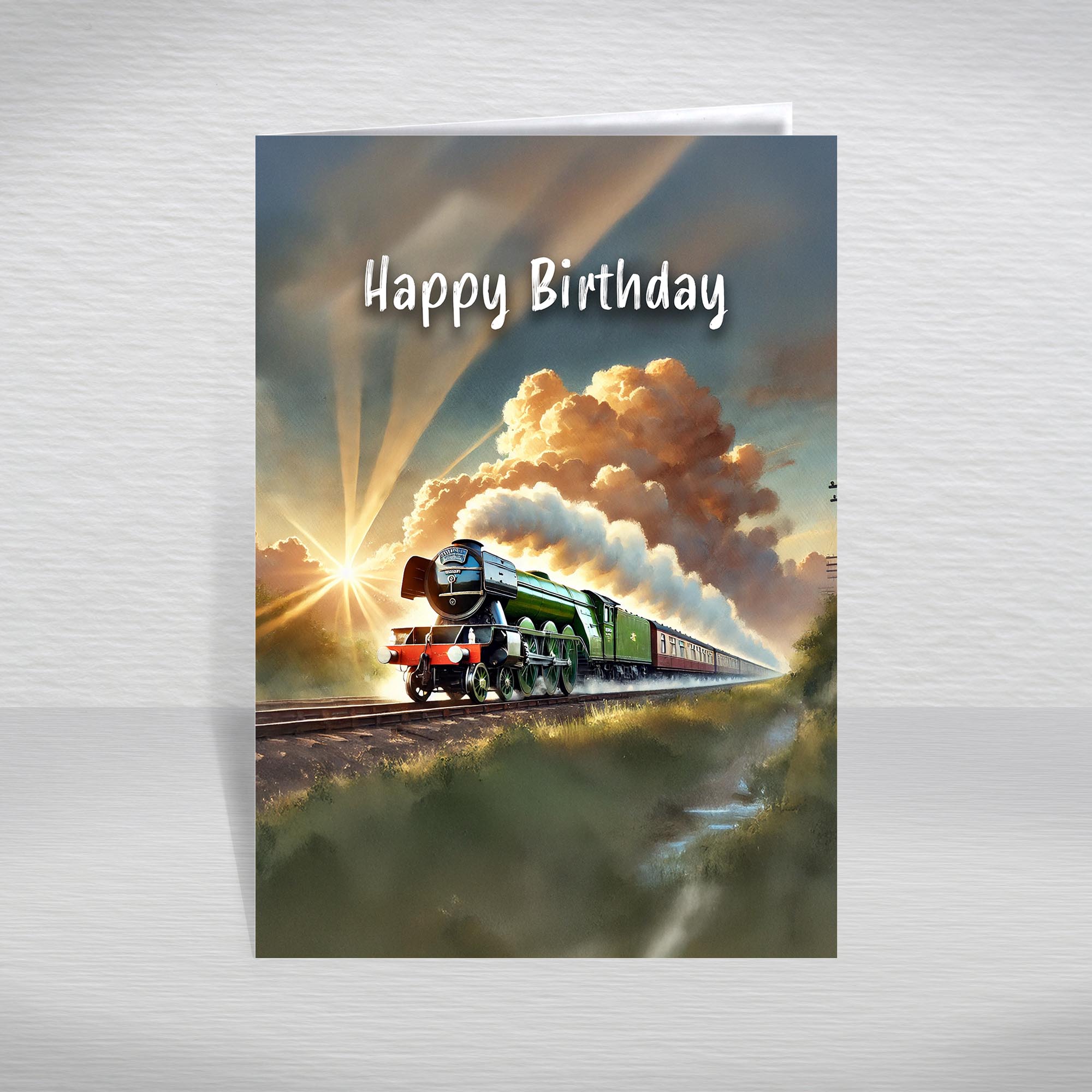
LNER Class A1 (Gresley original)
The LNER Class A1 was Sir Nigel Gresley's first three-cylinder Pacific design, prepared for the Great Northern Railway in 1921 and built from 1922, Britain's first numerous Pacific class and the foundation of the LNER's East Coast main-line express working for forty years. Fifty-two engines were built between April 1922 and 1925 at Doncaster Works (the Plant) and the North British Locomotive Company of Glasgow.
The first two engines, Nos 1470 Great Northern and 1471 Sir Frederick Banbury, were completed at Doncaster in April and May 1922, just months before the GNR's absorption into the LNER at the 1923 Grouping. Subsequent production extended through 1925 under LNER ownership and gave the East Coast Joint Pacific working its standard motive power.
The class introduced Gresley's patent conjugated valve gear, a 2:1 lever deriving the inside cylinder's motion from the two outside cylinders, saving weight and complication compared with three independent sets of valve gear. The arrangement became Gresley's signature feature and was subsequently applied to most of his three-cylinder designs including the A4, V2, and P1 classes.
The A1's original boiler pressure of 180 psi was found to limit the design's capability against Collett's GWR Castles in the celebrated 1925 LNER/GWR Locomotive Exchanges, when the Castles outperformed the A1s in dynamometer-car tests. From 1928 onwards Gresley progressively rebuilt the A1s to A3 standard with raised 220 psi boiler pressure and long-travel valves; by 1948 all 52 original A1s had been rebuilt and the original A1 form was extinct in regular service.
One A1 became famous beyond the railway world: No. 4472 Flying Scotsman, completed at Doncaster on 24 February 1923 and named after the celebrated London–Edinburgh service. The engine was the first British steam locomotive officially recorded at 100 mph (on 30 November 1934 between Leeds and York). Rebuilt to A3 standard in January 1947, the engine became one of the most celebrated British locomotives of all time. Sold to Alan Pegler on withdrawal from BR in 1963, it toured the United States in 1969–1970 and Australia in 1988–1989, passed through several private owners, and was acquired for the National Collection in 2004 for £2.3 million.
One A1 had a particularly controversial late-life modification. In September 1945 Edward Thompson rebuilt No. 4470 Great Northern, the 1922 prototype, to a unique two-cylinder Pacific configuration becoming the LNER A1/1. The rebuild was strongly criticised by Gresley admirers as the destruction of an irreplaceable historic engine. The rebuilt 4470 worked in BR service until 1962. None of the other original A1s was preserved; only Flying Scotsman in its A3 rebuild form survives, after the most complex preservation history of any British steam locomotive.
Design and development
By 1921 Sir Nigel Gresley had been Great Northern Railway Locomotive Engineer for ten years and had observed the increasing demands of East Coast main-line traffic. The existing GNR Large Atlantic expresses, capable as they were, were close to their limits with the heavier post-war loadings. American railways had developed the 4-6-2 Pacific configuration extensively from 1900 onwards; the GWR had built The Great Bear in 1908 as Britain's first Pacific but had not pursued the type in production. Gresley designed the A1 to bring numerous-Pacific working to the East Coast main line.
The design was a three-cylinder 4-6-2 with Gresley's patent conjugated valve gear (a 2:1 lever derivation of the inside cylinder's motion from the two outside cylinders), a wide Belpaire firebox supported by the trailing axle, and a parallel boiler at 180 psi. The first two engines, Nos 1470 Great Northern and 1471 Sir Frederick Banbury, were completed at Doncaster Works in April and May 1922, just months before the GNR's absorption into the LNER at the 1923 Grouping. Production continued under LNER ownership from 1923 to 1925, totalling 52 engines built across Doncaster and the North British Locomotive Company of Glasgow.
The original A1 boiler pressure of 180 psi was found to limit the design's capability against Collett's GWR Castles in the celebrated 1925 LNER/GWR Locomotive Exchanges, when the Castles outperformed the A1s in dynamometer-car tests. From 1928 onwards Gresley progressively rebuilt the A1s to A3 standard, with raised 220 psi boiler pressure, long-travel valves, and other detail improvements. The rebuilding was protracted; by 1948 all 52 original A1s had been rebuilt to A3 form.
One A1 had a particularly controversial late-life modification. In September 1945 Edward Thompson rebuilt No. 4470 Great Northern, the original 1922 prototype, to a unique two-cylinder Pacific configuration with a substantially modified frame and boiler, becoming the LNER A1/1 prototype. The rebuild was strongly criticised by Gresley admirers as the destruction of an irreplaceable historic engine. The rebuilt 4470 worked in BR service until 1962 but the original 1922 prototype A1 form was thereby extinguished.
Service and withdrawals
The A1s worked the principal LNER East Coast main-line expresses for 25 years before progressive A3 conversion. The Flying Scotsman service (introduced as a non-stop summer-only working in 1928, the first regular non-stop steam-hauled service in the world for the 392-mile journey) was an A1 roster, made possible by the corridor tender that allowed crew changeover en route. The 1925 LNER/GWR Locomotive Exchanges, in which 4474 Victor Wild ran on the GWR and a Castle ran on the LNER, contributed materially to the A3 development.
Conversion to A3 standard was progressive from 1928 to 1948. The A3 rebuilds had higher boiler pressure (220 psi), long-travel valves, and other detail improvements that gave them a substantial performance advantage over the original A1 form. By 1948 all 52 original A1s had been rebuilt; only the unique Thompson A1/1 No. 4470 retained any pretence to the original 1922 design.
British Railways inherited the entire A3 fleet in 1948, plus the unique A1/1 4470. The A3s remained in front-line East Coast main-line service through to the early 1960s, when the Deltic diesels progressively displaced them. The last A3 in BR service was No. 60052 Prince Palatine, withdrawn in January 1966.
Of the 52 original A1s, only one example survives: No. 60103 Flying Scotsman (originally GNR 1472, then LNER 4472, 502, 103). Built at Doncaster in February 1923, among the earliest 1923 LNER-period engines, and rebuilt to A3 standard in January 1947. The engine's preservation history is one of the most complex of any British steam locomotive: bought from BR by Alan Pegler in 1963; toured the United States 1969–1970; toured Australia 1988–1989; subsequently passed through several private owners before being acquired for the National Collection in 2004. Restored at the National Railway Museum 2006–2016 and currently main-line registered.
Identification features
The original 1922 Gresley Pacific outline, a three-cylinder 4-6-2 with Gresley conjugated valve gear, parallel boiler, and high-pitched cab. The class was the first British Pacific in numbers and established the basic Gresley express engine appearance that the A3 (1928 development) and A4 (1935 streamlined development) extended. As built the original A1s wore GNR Apple Green livery; from 1923 LNER Apple Green; from 1928 onwards examples were rebuilt to A3 standard with higher boiler pressure and reclassified.
Numbers and names
1470–1471Doncaster prototype batch, 1922, Great Northern and Sir Frederick Banbury
- 1470Great Northern
- 1471Sir Frederick Banbury
1472–14811923 production
- 1472
- 1473
- 1474
- 1475
- 1476
- 1477
- 1478
- 1479
- 1480
- 1481
2543–2562NBL-built batch 1924
- 2543
- 2544
- 2545
- 2546
- 2547
- 2548
- 2549
- 2550
- 2551
- 2552
- 2553
- 2554
- 2555
- 2556
- 2557
- 2558
- 2559
- 2560
- 2561
- 2562
2563–2572Doncaster 1924
- 2563
- 2564
- 2565
- 2566
- 2567
- 2568
- 2569
- 2570
- 2571
- 2572
2573–2582Doncaster 1925
- 2573
- 2574
- 2575
- 2576
- 2577
- 2578
- 2579
- 2580
- 2581
- 2582
2543–2582
- 2543
- 2544
- 2545
- 2546
- 2547
- 2548
- 2549
- 2550
- 2551
- 2552
- 2553
- 2554
- 2555
- 2556
- 2557
- 2558
- 2559
- 2560
- 2561
- 2562
- 2563
- 2564
- 2565
- 2566
- 2567
- 2568
- 2569
- 2570
- 2571
- 2572
- 2573
- 2574
- 2575
- 2576
- 2577
- 2578
- 2579
- 2580
- 2581
- 2582
4470–4475 renumberedGresley A1 retentions
- 4470
- 4471
- 4472
- 4473
- 4474
- 4475
4480–4481 renumbered
- 4480
- 4481
Great Northern Railway / LNER Nos 1470–1471 (Doncaster prototype batch, 1922, Great Northern and Sir Frederick Banbury); 1472–1481 (1923 production); 2543–2562 (NBL-built batch 1924); 2563–2572 (Doncaster 1924); 2573–2582 (Doncaster 1925); 2543–2582 ranges. Renumbered 4470–4475 (Gresley A1 retentions) and 4480–4481 in the 1946 LNER scheme. From 1928 onwards progressive rebuilding to A3 standard saw most engines reclassified A3 with separate later numbering. By 1948 the original A1 form was extinct.
Notable locomotives
1470 Great Northern (later 4470, then A1/1 prototype 1945), the first of class, completed at Doncaster in April 1922. The first British Pacific in regular service. Rebuilt by Thompson in September 1945 to a unique two-cylinder configuration that became the prototype LNER A1/1, a rebuild that was strongly criticised by Gresley admirers as the destruction of the original prototype Pacific. The rebuild was scrapped in 1962.
1471 Sir Frederick Banbury (later 4471), second of class, completed Doncaster May 1922. Named after the GNR's Chairman 1911–1922.
1472 / 4472 Flying Scotsman, the most famous British steam locomotive. Completed at Doncaster on 24 February 1923 (sometimes erroneously dated to 1922). Originally numbered 1472, renumbered 4472 in 1924, 502 in 1946, and 60103 by BR. On 30 November 1934 became the first British steam locomotive to be officially recorded at 100 mph. Rebuilt to A3 standard in January 1947, in which form it has remained ever since. Sold to the businessman Alan Pegler in 1963 on withdrawal from BR; toured the United States in 1969–1970 and Australia in 1988–1989; subsequently bought by Jeremy Marchant, then by Tony Marchington, and finally for the National Collection in 2004 after a complex period of private and public ownership. Restored at the National Railway Museum 2006–2016 and currently main-line registered. Operated as preserved A3 60103.
2580 Shotover (later 4480), first NBL-built engine, completed 1924. Withdrawn 1962 in A3 form.
Allocations and regions
GNR / LNER era (1922–1947): the class was concentrated on the principal East Coast express services. Major A1 allocations were at King's Cross Top Shed (the largest contingent), Doncaster, York, Newcastle Heaton, and Edinburgh Haymarket. The class worked the Flying Scotsman, the Capitals Limited, the West Riding Limited, and the principal Anglo-Scottish expresses.
Progressive A3 conversion (1928–1948): from 1928 onwards Gresley began rebuilding A1s to A3 standard with higher 220 psi boiler pressure, long-travel valves, and other detail improvements. The conversion was progressive rather than wholesale, engines were rebuilt as their original boilers came due for renewal. By 1948 the entire class had been rebuilt and the original A1 form was extinct in regular service.
Classification reshuffles: from 1945 the original A1 class was reclassified A10 by Thompson to free up the A1 designation for his proposed new prototype Pacific. Thompson rebuilt No. 4470 Great Northern in September 1945 to a unique configuration that became LNER class A1/1, a controversial rebuild that effectively destroyed the prototype A1 of 1922 in the eyes of many enthusiasts. After 1948 the A1 designation was used for the new Peppercorn A1 Class of 1948–1949.
Livery history
GNR (1922): the original two prototypes (1470 and 1471) were outshopped in standard GNR Apple Green with elaborate black-and-cream lining, polished brass safety-valve casing, and the GNR coat of arms. Production of subsequent engines transferred to LNER ownership at the 1923 Grouping.
LNER Apple Green (1923–1939): standard LNER apple green with yellow-and-black lining; the LNER coat of arms or "L.N.E.R." lettering on the tender. The brass nameplates and polished metalwork reflected the class's express role.
LNER unlined black (1942–1949): wartime austerity saw most A1/A3 examples in unlined plain black with shaded "L.N.E.R." lettering. Apple green progressively returned post-war.
British Railways (1948–onwards): initially apple green with the early lion-and-wheel emblem; from 1949 BR Brunswick green with the early then late BR crest. The preserved 60103 Flying Scotsman has been restored in successive preservation periods to LNER apple green, BR Brunswick green, and BR experimental wartime LNER livery.
Preservation status
One example of the original A1 design survives, in its rebuilt A3 form: No. 60103 Flying Scotsman (originally GNR 1472, then LNER 4472). Built at Doncaster Works on 24 February 1923 as one of the earliest LNER-period A1s. Rebuilt to A3 standard in January 1947, the form in which the engine has remained ever since.
The preservation history is among the most complex of any British steam locomotive. Withdrawn from BR service in January 1963, the engine was sold to the businessman Alan Pegler, among the first British steam locomotives to be saved by individual rather than public purchase. Pegler operated the engine on charter trains in the UK and on a costly North American tour in 1969–1970, after which the engine was effectively stranded in the United States until rescued by William McAlpine in 1973. Subsequently toured Australia in 1988–1989 (where it crossed the continent on the Indian-Pacific). Returned to the UK and passed through ownership of Tony Marchington and others before being acquired for the National Collection in 2004 for £2.3 million.
Restored at the National Railway Museum between 2006 and 2016, a major and complex restoration that overhauled the boiler, frame, and motion to main-line standards. Currently main-line registered and a regular performer on charter services across the UK network. Carried in preservation: LNER apple green (most periods); BR Locomotive Green (1990s); BR wartime experimental dark green (occasional). The engine is, by some measures, the most-photographed and most-celebrated British steam locomotive in preservation.
Of the other 51 original A1s, none was preserved, all were rebuilt to A3 standard before withdrawal, and the rebuilt A3s were progressively scrapped between 1959 and 1966.