BR Standard Class 8 Duke of Gloucester
The BR Standard Class 8 No. 71000 Duke of Gloucester is the unique single member of the BR Standard Class 8 Pacific design, built at Crewe Works in May 1954 as the first of an intended class of twelve, but ultimately the only one. The 1955 Modernisation Plan, which committed BR to mass replacement of steam by diesel and electric traction, ended any prospect of further construction.
The engine was R. A. Riddles' attempt to extend the BR Standard family to the highest power class, a three-cylinder Pacific with British Caprotti rotary-cam valve gear, a 250 psi boiler larger than the Britannia's, and a tractive effort of 39,080 lbf, the highest of any BR Standard. It was the only BR Standard class to depart from the two-cylinder simplicity that defined the rest of the family, and the only one to use Caprotti gear.
Initial service was disappointing. The draughting arrangement, a single conventional blastpipe, was poorly proportioned for the boiler's size and the engine's steaming was inconsistent under heavy load. The Caprotti gear required maintenance practices unfamiliar to crews accustomed to Walschaerts. Performance was below expectations and the Duke was widely regarded by Crewe North crews as inferior to the existing LMS Princess Coronations.
The Duke was withdrawn at Crewe North in November 1962 after only eight years of service and a recorded mileage of approximately 270,000 miles, strikingly low. The cylinders were sectioned for display at the Science Museum, an act that initially seemed to preclude any prospect of preservation. The engine was sent to Crewe Works for use as a stationary boiler, then to Woodham Brothers' scrapyard at Barry in 1967.
The preservation story is itself remarkable. A group led by Bob Mears bought the engine from Barry in 1974 and began a long restoration at Loughborough. The restoration team, recognising that the original design had been fundamentally compromised by poor draughting, fitted a Lemaître multiple-jet blastpipe and a Kylpor-style ejector, transforming the steam circuit. The rebuilt Duke ran for the first time in preservation in November 1986 and proved to be the powerful, free-running engine the original design had always promised. Subsequent main-line testing has recorded sustained performance well above any service-period expectation.
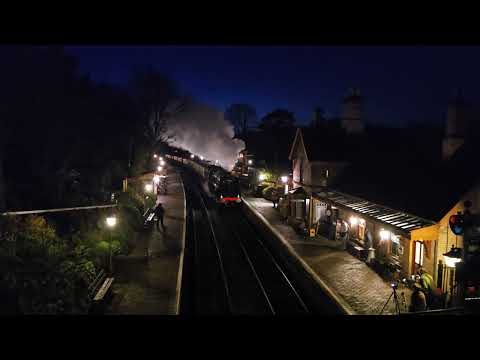
The Duke is currently main-line registered at the Great Central Railway in Loughborough, a working monument to both the limitations of mid-century design compromise and the capability of dedicated preservation engineering.
Design and development
The BR Standard programme of 1951 had set out a range of standardised steam classes from Class 2 to Class 7, the highest-rated being the Britannia Pacific at 32,150 lbf tractive effort. Service experience showed that the heaviest Anglo-Scottish and Western Region expresses needed something more powerful, and R. A. Riddles proposed a Class 8 Pacific that would extend the BR Standard family to the highest power class.
The Class 8 design used the basic Britannia layout enlarged with a wider firebox, larger boiler at 250 psi, and three cylinders rather than two, the only BR Standard class to depart from the two-cylinder simplicity that defined the rest of the family. British Caprotti rotary-cam valve gear was specified in place of the conventional Walschaerts arrangement, intended to give precise valve events at high speed.
The single example, No. 71000 Duke of Gloucester, was completed at Crewe Works in May 1954. Initial trials revealed serious deficiencies. The draughting arrangement, a single conventional blastpipe, was poorly proportioned for the boiler's size and the engine's steaming was inconsistent under heavy load. The Caprotti gear required maintenance practices unfamiliar to crews accustomed to Walschaerts. Performance in regular service was disappointing relative to expectations.
The 1955 Modernisation Plan committed BR to mass replacement of steam by diesel and electric traction, and any prospect of further Class 8 construction was abandoned. The Duke remained a unique one-off, built as the first of an intended class of twelve, but ultimately the only one. Withdrawn at Crewe North in November 1962 after only eight years of service, the engine had a working life of less than a decade.
Service and withdrawals
The Duke worked from Crewe North on the principal West Coast Main Line expresses, the Royal Scot, the Mid-day Scot, the Caledonian, the Mancunian, and selected Manchester/Liverpool–Glasgow services. Drivers reported that the engine could pull well at moderate cut-offs but became uneven at the high power outputs the class was nominally designed for. Coal consumption was high relative to the existing Princess Coronations, and the engine was widely regarded as inferior to the LMS Pacifics it had been intended to supplement.
The 1955 Modernisation Plan, the rapid arrival of West Coast electric and diesel traction, and the engine's indifferent reputation combined to make 71000's withdrawal a matter of when rather than if. The engine was withdrawn at Crewe North in November 1962 with a recorded mileage of approximately 270,000 miles, strikingly low for an eight-year career.
Following withdrawal, the cylinders were sectioned for display at the Science Museum, an act that initially seemed to preclude any prospect of preservation. The engine was sent to Crewe Works for use as a stationary boiler, then to Barry scrapyard in 1967, at which point a preservation group led by Bob Mears began the long campaign to rescue it.
The preservation story is itself remarkable. Rescued from Barry in 1974, the engine was restored at Loughborough between 1974 and 1986. The restoration team, recognising that the original design had been fundamentally compromised by poor draughting, replaced the original blastpipe with a Lemaître multiple-jet arrangement and added a Kylpor-style exhaust. The result, when the engine ran for the first time in preservation in 1986, was a transformation: the rebuilt Duke proved to be the powerful, free-running engine it had always been intended to be. Subsequent main-line testing has recorded sustained performance comfortably above any service-period expectation.
Identification features
A unique three-cylinder BR Standard Pacific outline, distinguishable from the Britannia by its larger boiler, taller running plate, and the three-cylinder layout with no inside-cylinder steam beat (the Caprotti gear and three-cylinder layout giving six exhaust beats per revolution rather than four). The engine carried the BR Standard family appearance, high running plate, mechanical lubrication, simple cab outline, but the Caprotti valve gear is recognisable from the rotating cam-shaft drives visible above the leading coupled axle. Painted throughout in BR lined Locomotive Green with the late BR crest. The engine carries the BR No. 71000 and the brass nameplate Duke of Gloucester on the leading splasher.
Numbers and names
BR No. 71000, the unique Class 8 Pacific. Numbered in the 71000 series allocated to Standard Class 8 (with subsequent class 8 candidates having been planned at 71001 onwards but never built). The engine carried no other number throughout its working life.
Notable locomotives
71000 Duke of Gloucester, the unique single member of the class. Built at Crewe Works in May 1954 as the first of an intended class of twelve Class 8 Pacifics; the 1955 Modernisation Plan ended further construction. Withdrawn from Crewe North in November 1962 with relatively low mileage compared with sister Pacifics. After eight years at Crewe Works as a static exhibit and then transfer to Barry scrapyard, the engine was rescued for preservation in 1974. Returned to working order at Loughborough in 1986 with substantial design improvements addressing the original draughting deficiencies, improvements that revealed what the engine could have been in service. Now resident at the Great Central Railway and main-line registered.
Allocations and regions
BR service (1954–1962): the engine was allocated solely to Crewe North shed for the entirety of its eight-year BR career. It worked principally on Anglo-Scottish expresses on the West Coast Main Line, the Royal Scot, the Mid-day Scot, the Caledonian, the Mancunian and selected Liverpool/Manchester–Glasgow services. Although a Class 8 by power rating, the engine's indifferent steaming meant that crews often preferred the LMS Princess Coronation Pacifics for the heaviest workings.
Preservation (1968–present): after withdrawal No. 71000 was rescued from Woodham Brothers' Barry scrapyard by a preservation group led by Bob Mears. The engine has been resident at the Great Central Railway in Loughborough for most of its preservation life and has been main-line registered for charter and special-event work since the 1990s.
Livery history
BR (1954–1962): BR lined Brunswick green with the late-style BR crest, large nameplate Duke of Gloucester on the leading splasher, polished metalwork around the cab. The engine wore this livery throughout its eight-year BR career.
Preservation: the engine has been maintained throughout in BR Brunswick green, although the precise lining details have varied between successive overhauls. Currently in BR late-period crested green livery at the Great Central Railway.
Preservation status
The unique No. 71000 Duke of Gloucester survives in preservation. Withdrawn from Crewe North in November 1962, the engine was sent to Crewe Works for use as a stationary boiler before being moved to Woodham Brothers' scrapyard at Barry in 1967. The cylinders had been sectioned and removed for display at the Science Museum, an act that initially seemed to make preservation impractical.
A preservation group led by Bob Mears bought the engine from Barry in 1974 and began a long restoration at Loughborough on the Great Central Railway. The restoration team made several substantial design improvements that addressed the original draughting deficiencies, replacing the original blastpipe with a Lemaître multiple-jet exhaust, fitting a Kylpor-style ejector, and improving the steam circuit. The rebuilt Duke ran for the first time in preservation in November 1986 and proved to be the powerful, free-running engine the original design had always promised.
The engine has been main-line registered for charter and special-event work since the 1990s and is currently based at the Great Central Railway in Loughborough. Recent main-line testing has recorded performance well above any service-period expectation, including a 90+ mph run on test in 2000. The Duke is a working monument to both the limitations of mid-century design compromise and the capability of dedicated preservation engineering.