GWR 6800 Grange Class
The GWR 6800 Grange Class was Charles Collett's lighter mixed-traffic 4-6-0 for the Great Western Railway, designed in 1936 to work the cross-country and secondary main-line routes that the heavier Hall Class was barred from. Eighty engines were built at Swindon Works between 1936 and 1939.
The class was a development of the Hall Class with smaller 5 ft 8 in driving wheels (against the Hall's 6 ft 0 in), the same wheel diameter as the 4300 Mogul. The result was a 4-6-0 with slightly higher tractive effort than the Hall, lower axle loading suited to the lighter routes, and broadly similar performance characteristics. The Grange was built using parts salvaged from withdrawn 4300 Moguls, frames, motion components and wheel centres being recovered and re-used in the Grange construction. The first engine, No. 6800 Arlington Grange, was completed in August 1936.
The Grange stood between the Hall and the Manor Class (1938) in the GWR's hierarchy of mixed-traffic 4-6-0s. The Manor was a lighter still development for the very lightest routes; the Grange handled the medium-weight cross-country and secondary main-line work, the South Wales valley services, the Cambrian Coast main line, the secondary routes around the West Midlands, and the heavier cross-country freight from Cardiff and Bristol.
The Grange's reputation was high. In the LNER/SR/LMS exchange trials of 1948, when British Railways tested locomotives from each pre-nationalisation company against each other, No. 6804 Brockington Grange held its own against the LMS Black Five and the LNER B1. British Railways continued the class on similar duties through the 1950s; withdrawal began in 1959 and the last Granges in BR service were withdrawn at the end of 1965.
None of the 80 original Granges was preserved. Several were sent to Woodham Brothers' scrapyard at Barry in the early 1960s but unlike many GWR classes that were rescued from Barry in the 1970s, no Grange found a preservation buyer. The class was extinct in the original sense from 1965 onwards.
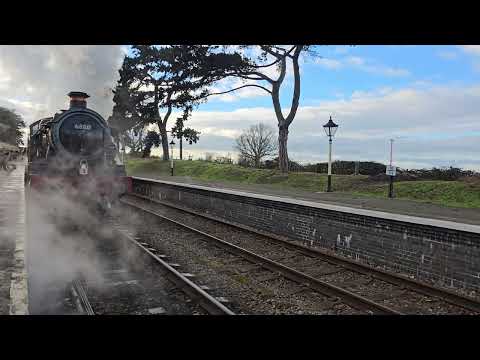
No. 6880 Betton Grange is a new-build engine constructed by the Llangollen-based 6880 Betton Grange Society to recreate the class. Construction began in 1998 using the boiler from withdrawn Modified Hall No. 7927 and other recovered GWR parts. Betton Grange was steamed for the first time at Llangollen on 5 November 2024, almost 60 years after the last original Grange was withdrawn from BR service. The engine has been outshopped in lined GWR Middle Chrome Green livery, taking the next-in-series GWR number as if the class had run for one more name.
Design and development
By the mid-1930s the Great Western Railway's cross-country and lighter main-line routes were being worked by an ageing fleet of 4300 Moguls, Saints, and pre-grouping types absorbed at the Grouping. The new Hall Class of 1928 was widely admired but its 18-ton 19-cwt axle load barred it from many of these routes, particularly the Cambrian Coast lines and parts of the Welsh Marches.
Charles Collett's answer was a lighter mixed-traffic 4-6-0 with smaller driving wheels, the Grange Class. The design used the same boiler, cylinders and Castle-pattern double side-window cab as the Hall, but with 5 ft 8 in driving wheels (the same as the 4300 Mogul) rather than the Hall's 6 ft 0 in. The result was a 4-6-0 with slightly higher tractive effort than the Hall, lower axle loading suited to the lighter routes, and broadly similar performance characteristics.
The Grange was built at Swindon Works using parts salvaged from withdrawn 4300 Moguls, frames, motion components and wheel centres being recovered and re-used in the Grange construction. The first engine, No. 6800 Arlington Grange, was completed in August 1936; the eightieth, No. 6879 Overton Grange, in February 1939. The class was named for English country houses ending in "Grange", Arlington Grange, Brockington Grange, Helmingham Grange, Lansdowne Grange and so on, following the GWR's house-name naming convention.
Plans for further Granges existed (the 6880–6939 number range had been reserved) but the outbreak of war in 1939 and post-war material restrictions meant they were never built. After the war the GWR designed the 7800 Manor Class (1938) as a lighter still 4-6-0 to fill the same niche on routes the Granges could not work, and the Grange thus stood between the Hall and the Manor in the GWR's hierarchy of mixed-traffic 4-6-0s.
Service and withdrawals
The Granges worked on every kind of Western Region duty their power and route availability allowed. They were particularly associated with the South Wales valley services (where their lighter axle loading suited the heavily-graded mineral lines), the Cambrian Coast main line west of Wolverhampton, the secondary main-line routes around the West Midlands, and the heavier cross-country freight services from Cardiff and Bristol.
Their performance was widely admired. In the LNER/SR/LMS exchange trials of 1948, when British Railways tested locomotives from each pre-nationalisation company against each other, Grange No. 6804 Brockington Grange represented the GWR mixed-traffic class against the LMS Black Five and the new LNER B1. The Grange held its own against both, although the trials revealed that all three classes were competitive within their respective routes.
British Railways inherited the entire class of 80 in 1948. Withdrawal began in 1959 and accelerated through the early 1960s as the Western Region steam fleet was progressively replaced by diesel-hydraulic and diesel-electric traction. The last Granges in BR service were withdrawn at the end of 1965, slightly later than the Hall Class but earlier than the lighter Manors.
None of the 80 Granges was preserved. Several were sent to Woodham Brothers' scrapyard at Barry but unfortunately none was rescued for preservation in the 1970s when many other GWR engines were saved. The class was extinct in the original sense from 1965, until the new-build 6880 Betton Grange programme finally returned an engine of the class to traffic in 2024.
Identification features
Visually similar to the Hall Class but distinguishable by smaller driving wheels (5 ft 8 in against the Hall's 6 ft 0 in). The Grange uses the same boiler, same cylinders, same Castle-pattern double side-window cab, and same livery as the Hall, what distinguishes them at rest is the wheel diameter, which is most visible in the gap between the running plate and the wheel rim. The Grange is named after English country houses ending in "Grange" (e.g. Frilford Grange, Stinsford Grange, Aller Grange) following the GWR's house-name convention. Standard GWR Middle Chrome Green livery with full lining; BR lined Locomotive Green from the late 1950s.
Numbers and names
6800–6879
- 6800
- 6801
- 6802
- 6803
- 6804
- 6805
- 6806
- 6807
- 6808
- 6809
- 6810
- 6811
- 6812
- 6813
- 6814
- 6815
- 6816
- 6817
- 6818
- 6819
- 6820
- 6821
- 6822
- 6823
- 6824
- 6825
- 6826
- 6827
- 6828
- 6829
- 6830
- 6831
- 6832
- 6833
- 6834
- 6835
- 6836
- 6837
- 6838
- 6839
- 6840
- 6841
- 6842
- 6843
- 6844
- 6845
- 6846
- 6847
- 6848
- 6849
- 6850
- 6851
- 6852
- 6853
- 6854
- 6855
- 6856
- 6857
- 6858
- 6859
- 6860
- 6861
- 6862
- 6863
- 6864
- 6865
- 6866
- 6867
- 6868
- 6869
- 6870
- 6871
- 6872
- 6873
- 6874
- 6875
- 6876
- 6877
- 6878
- 6879
6800–6824
- 6800
- 6801
- 6802
- 6803
- 6804
- 6805
- 6806
- 6807
- 6808
- 6809
- 6810
- 6811
- 6812
- 6813
- 6814
- 6815
- 6816
- 6817
- 6818
- 6819
- 6820
- 6821
- 6822
- 6823
- 6824
6825–6879
- 6825
- 6826
- 6827
- 6828
- 6829
- 6830
- 6831
- 6832
- 6833
- 6834
- 6835
- 6836
- 6837
- 6838
- 6839
- 6840
- 6841
- 6842
- 6843
- 6844
- 6845
- 6846
- 6847
- 6848
- 6849
- 6850
- 6851
- 6852
- 6853
- 6854
- 6855
- 6856
- 6857
- 6858
- 6859
- 6860
- 6861
- 6862
- 6863
- 6864
- 6865
- 6866
- 6867
- 6868
- 6869
- 6870
- 6871
- 6872
- 6873
- 6874
- 6875
- 6876
- 6877
- 6878
- 6879
GWR Nos 6800–6879. Built in two main batches at Swindon under Lots 297 (6800–6824, 1936–1937) and 312 (6825–6879, 1937–1939). British Railways retained the GWR numbers without alteration. The class was constructed using the surviving frames, motion and other parts from withdrawn 4300 Moguls, a Collett economy that recovered serviceable components from older engines.
Notable locomotives
6800 Arlington Grange, the prototype, completed at Swindon in August 1936. Withdrawn 1959. Not preserved.
6804 Brockington Grange, selected for the LNER/SR/LMS exchange trials of 1948 representing the GWR mixed-traffic class. Performed creditably against the LMS Black Five and LNER B1 in those trials. Withdrawn 1964.
6879 Overton Grange, last of the original class, completed at Swindon in February 1939.
6880 Betton Grange, a new-build engine constructed by the Llangollen-based 6880 Betton Grange Society to recreate the class after no original Grange was preserved. Construction began in 1998 and the engine was steamed for the first time in 2024, almost 60 years after the last original Grange was withdrawn from BR service. The engine carries the next-in-series number 6880, continuing the original 6800–6879 GWR sequence.
Allocations and regions
GWR era (1936–1947): from introduction the class was distributed across the lighter routes that the Hall Class could not work. Cardiff Canton and Newport Ebbw Junction had the largest contingents for the South Wales valley services; Worcester, Stafford Road (Wolverhampton), and Tyseley (Birmingham) for the Welsh Marches and cross-country routes; Cardiff East Dock for the docks-related freight. Smaller numbers at Newton Abbot for the Devon and Cornish secondary routes.
British Railways Western Region (1948–1965): the class continued widely distributed across the lighter Western Region routes. By the early 1960s the Granges were concentrated at Cardiff East Dock, Newport Ebbw Junction, Severn Tunnel Junction, Westbury and Worcester for the residual fitted-freight and parcels work as steam was withdrawn from the Western Region. The last Granges were withdrawn at the end of 1965.
Livery history
GWR (1936–1947): Middle Chrome Green with black-and-orange lining, polished brass safety-valve casing, copper-capped chimney, and either the GWR roundel or "Great Western" lettering on the tender. Wartime examples (1942 onwards) sometimes appeared in unlined plain green or plain black for material economy.
British Railways early (1948–1956): BR mixed-traffic black with red, cream and grey lining; early lion-and-wheel emblem on the tender.
British Railways late (1956–1965): BR lined Brunswick green with the late BR crest. Most Granges spent the bulk of their BR years in this livery.
Preservation (Betton Grange, 2024–): the new-build 6880 was outshopped at Llangollen in lined GWR Middle Chrome Green livery, recreating the engines' GWR-era appearance.
Preservation status
None of the original 80 Granges was preserved. Several were sold to Woodham Brothers' scrapyard at Barry in the early 1960s but, unlike many GWR classes that were rescued from Barry in the 1970s, no Grange found a preservation buyer. All 80 original engines were therefore scrapped. The class was extinct in the original sense from 1965 onwards.
No. 6880 Betton Grange is a new-build engine constructed by the Llangollen-based 6880 Betton Grange Society to recreate the class. Construction began in 1998 using the boiler from withdrawn Modified Hall No. 7927 and other recovered GWR parts. The project was a long undertaking, over 25 years from start to first steaming, and was widely supported across the GWR preservation community. The engine carries the next-in-series number 6880, continuing the original 6800–6879 GWR sequence as if the class had run for one more name.
Betton Grange was steamed for the first time at Llangollen on 5 November 2024, almost 60 years after the last original Grange was withdrawn from BR service. The engine has been outshopped in lined GWR Middle Chrome Green livery and is intended to operate on heritage railways and (in due course) on the main-line network. It is the third major new-build GWR steam locomotive after 2999 Lady of Legend (a Saint converted from Hall 4942) and the converted Mogul 9351 at the West Somerset Railway.