LSWR M7
The LSWR M7 was Dugald Drummond's 0-4-4T suburban tank engine, introduced in 1897 for the LSWR's busy commuter services into Waterloo. The class was built in successive batches over fourteen years, 105 engines in total, across the M7, X14 and X14R sub-classes, at Nine Elms Works and afterwards Eastleigh. It was one of the most numerous LSWR tank classes and worked Southern Railway and BR Southern Region suburban and branch services for sixty-seven years.
The M7 was rugged and economical. The Drummond house style of inside cylinders, outside frames at the front, side tanks running the full length of the boiler, and an enclosed roomy cab gave the engines a free-running quality that allowed them to handle the heavy peak-hour suburban loadings into Waterloo without difficulty. Their tractive effort of 19,755 lbf was high for a 0-4-4T and contributed to a reputation as the equal of any contemporary suburban tank in Britain.
The class's original work, the busy services from Waterloo to Wimbledon, Twickenham, Kingston, Hampton Court and Reading, was progressively displaced by LSWR/SR third-rail electrification from 1916 onwards. The displaced M7s were transferred to outer-suburban services and the Western Section's rural branches.
From 1925 Maunsell's auto-train scheme saw 36 M7s fitted with push-pull gear for working with driving trailer carriages. The auto-train M7s allowed one-man operation on quiet country branches, the Lyme Regis branch, the Bishop's Lydeard branch, the Plymouth–Padstow stopping services, and dramatically extended the class's useful life beyond its original metropolitan role. The auto-train conversion is widely regarded as one of the most successful examples of late-life modernisation of British steam motive power.
British Railways inherited 100 surviving M7s in 1948 and the class continued in service through the 1950s and into the 1960s. The last M7 in BR service was No. 30055, withdrawn from Bournemouth in May 1964, sixty-seven years after the prototype had emerged from Nine Elms.
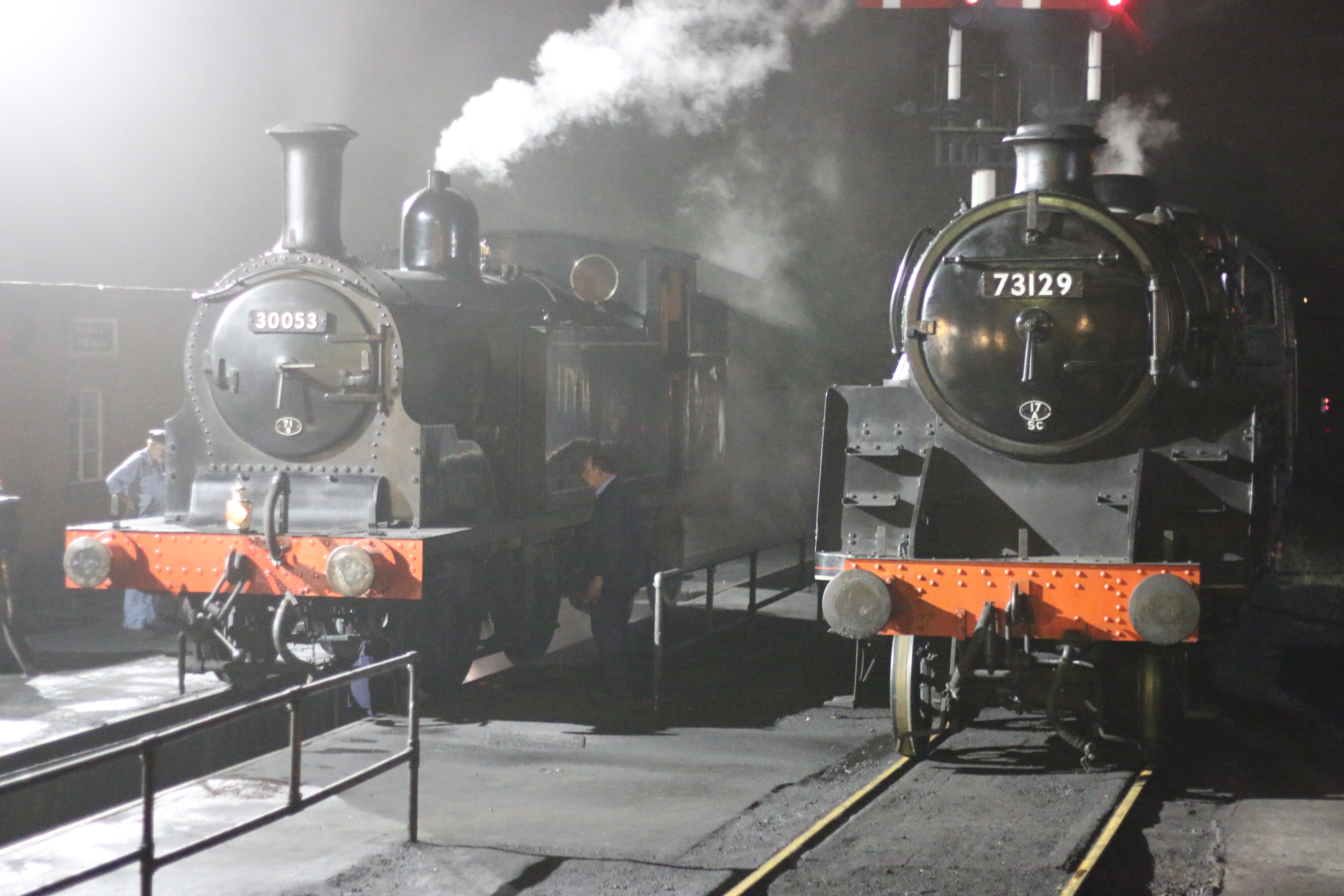
Two M7s are preserved: No. 30053 at the Swanage Railway (main-line registered) and the prototype No. 30245 in the National Collection at the National Railway Museum, York. The other 103 members of the class were scrapped.
Design and development
Dugald Drummond arrived at the London & South Western Railway in 1895 to find an LSWR fleet that included a substantial number of small Adams-pattern 0-4-4 tanks for suburban work into Waterloo. The Adams tanks were getting on in years and the LSWR's commuter loadings, particularly to Wimbledon, Hampton Court, Kingston and Reading, were rising rapidly with the suburban housing growth of the 1890s.
Drummond's answer was the M7, a 0-4-4 tank engine of his preferred Scottish-school design, inside cylinders, Stephenson valve gear, and a Drummond-pattern boiler. The first engine, No. 245, emerged from Nine Elms Works in May 1897. The class proved an immediate success: free-running, economical on coal, with sufficient tractive effort (19,755 lbf) to handle heavy short-distance commuter loadings on time.
Production continued in successive batches across fourteen years, with detail variations distinguishing the M7, X14 and X14R sub-classes. The M7 proper was the original 1897 design; the X14 of 1903 had detail modifications including a different cab; the X14R of 1911 introduced the side-window cab as standard. Total production reached 105 engines, all built at Nine Elms or Eastleigh.
From 1925 Maunsell's auto-train scheme saw 36 M7s fitted with push-pull gear for working driving trailer carriages on rural branches. The auto-train M7s, distinguishable by additional vacuum and air-pipe connections at front and rear, allowed one-man operation on quiet country branches and dramatically extended the useful life of the class beyond the urban suburban services for which they had been originally designed.
Service and withdrawals
The M7s were the LSWR's standard suburban tank engine for two and a half decades. They worked the busy services from Waterloo to Wimbledon, Twickenham, Kingston, Hampton Court and Reading; the Strawberry Hill commuter trains; and the Hampton Court boat-train connections. Few classes were so closely associated with a single piece of railway as the M7s with the LSWR's south-west London suburban network.
The introduction of LSWR/SR third-rail electrification on the inner suburban routes from 1916 onwards progressively displaced the M7s from their original metropolitan duties. The Hampton Court line was electrified in 1916; the Wimbledon–Sutton in 1929; the Kingston, Twickenham and Hounslow loops in 1930. The displaced M7s were transferred to outer-suburban services and to the Western Section branch lines.
From 1925 the auto-train conversion programme transformed the class's late-life prospects. Auto-fitted M7s worked the Lyme Regis branch (Axminster–Lyme Regis), the Bishop's Lydeard branch (Taunton–Minehead), the Plymouth–Padstow stopping services, and the Hampton Court branch through to electrification. The class was widely admired in this role for the sheer rugged simplicity of the equipment, an M7 and a single auto-trailer could keep a remote branch line alive.
British Railways inherited 100 surviving M7s in 1948. The class continued in service through the 1950s on similar duties, with progressive withdrawal from the late 1950s onwards. The last M7 in BR service was No. 30055, withdrawn from Bournemouth in May 1964, sixty-seven years after No. 245 had emerged from Nine Elms in 1897. The class lasted to the very end of Southern steam.
Identification features
Distinctively Drummond outline 0-4-4 tank with characteristic outside frames at the front (over the leading bogie), inside cylinders, a Drummond pattern dome on a saturated boiler, and a small bunker behind a roomy enclosed cab. Side tanks ran the full length of the boiler. Most retained side-window cabs throughout their service life. The class wore LSWR sage green with elaborate yellow lining; SR olive green from 1923; SR malachite from 1937; BR mixed-traffic black with red/cream/grey lining from 1948 (subsequently lined Locomotive Green from 1956). Auto-train fitted examples from 1925 carried distinctive vacuum and air-pipe connections at front and rear for working with driving trailer carriages.
Numbers and names
105–112
- 105
- 106
- 107
- 108
- 109
- 110
- 111
- 112
123–132
- 123
- 124
- 125
- 126
- 127
- 128
- 129
- 130
- 131
- 132
241–256
- 241
- 242
- 243
- 244
- 245
- 246
- 247
- 248
- 249
- 250
- 251
- 252
- 253
- 254
- 255
- 256
318–328
- 318
- 319
- 320
- 321
- 322
- 323
- 324
- 325
- 326
- 327
- 328
356–357
- 356
- 357
374–379
- 374
- 375
- 376
- 377
- 378
- 379
479–481
- 479
- 480
- 481
667–676
- 667
- 668
- 669
- 670
- 671
- 672
- 673
- 674
- 675
- 676
LSWR Nos 21–25, 35–60, 105–112, 123–132, 241–256, 318–328, 356–357, 374–379, 479–481, 667–676. Multiple sub-classes (M7, X14, X14R) reflect detail batches with progressive design changes between 1897 and 1911. Southern Railway from 1923 added 0 to all numbers; British Railways added 30000 from 1948.
Notable locomotives
53 (LSWR; later 30053), preserved at the Swanage Railway, currently main-line registered. Built at Nine Elms in October 1905 as one of the auto-train fitted examples. Withdrawn from Bournemouth in May 1964 as one of the last in service. Restored to working order at Steamtown Carnforth in 1980 and main-line steamed throughout the 1980s.
245 (LSWR; later 30245), preserved in the National Collection at the National Railway Museum, York. Built at Nine Elms in May 1897 as the prototype of the class. The oldest M7 to survive.
667 (LSWR; later 30667), the celebrated "Royal Engine" allocated to Strawberry Hill for the Royal Train workings to Hampton Court Palace through the 1900s. Withdrawn 1962.
30055, credited with the last main-line working of any M7, on Bournemouth empty stock movements during May 1964.
Allocations and regions
LSWR era (1897–1922): the class was originally concentrated on Waterloo suburban services, Nine Elms shed (London) held the largest contingent, working trains to Wimbledon, Twickenham, Kingston, Hampton Court and Reading. Smaller allocations at Nine Elms (running shed), Strawberry Hill, and Feltham handled the outer-suburban services. Bournemouth and Eastleigh received a few for the Bournemouth–Weymouth and Bournemouth–Salisbury services.
Southern Railway (1923–1947): from 1925 Maunsell's auto-train scheme saw 36 engines fitted with push-pull gear for working with driving trailer carriages on rural branches. These were dispersed widely across the Southern's Western and Central Sections, Plymouth Friary, Exmouth Junction, Wadebridge, Bournemouth Central, Eastleigh, Yeovil, Salisbury and Brighton.
British Railways Southern Region (1948–1964): the surviving M7s served on for 16 further years. By the mid-1950s most were on branch line and station pilot duties, with a few retained for empty stock workings at the larger London termini. The class lasted to the very end of Southern steam, with the last withdrawal at Bournemouth in May 1964.
Livery history
LSWR (1897–1922): Drummond's "passenger green", sage green with elaborate yellow and white lining, polished brass safety-valve casing and the LSWR coat of arms on the bunker. Auto-train fitted examples from 1916 carried additional yellow auto-train marker indications.
Southern Railway (1923–1947): initially retained LSWR green; from 1924 progressively repainted into Maunsell olive green. From 1937 the class adopted Bulleid malachite green with yellow Sunshine-style lettering, although wartime austerity saw most reverting to plain unlined black.
British Railways early (1948–1956): mixed-traffic black with red, cream and grey lining; early lion-and-wheel emblem on the bunker.
British Railways late (1956–1964): BR lined Brunswick green with the late BR crest. This was the dominant final livery, and the form in which preserved 30053 has been restored.
Preservation status
Two M7s are preserved:
- No. 30053 (LSWR No. 53), preserved at the Swanage Railway, currently main-line registered. Built at Nine Elms in October 1905 as one of the auto-train fitted examples. After purchase from BR by the Steamtown trust in 1965 the engine spent many years on display before being restored to working order in the 1980s. Currently main-line registered for occasional charter and special-event work and a regular performer at the Swanage Railway.
- No. 30245 (LSWR No. 245), preserved in the National Collection at the National Railway Museum, York. The prototype of the class, built at Nine Elms in May 1897. It is the oldest M7 to survive and the only one in original LSWR Drummond green livery in preservation. Currently a static exhibit.
The other 103 M7s were scrapped at South Wales scrapyards between 1937 and 1965.
Photographs