Catch Me Who Can
Catch Me Who Can was Richard Trevithick's 1808 demonstration locomotive, the engine that introduced the steam locomotive to the London public and the first locomotive ever to carry fare-paying passengers. Built by John Hazledine and John Urpeth Rastrick at Bridgnorth to Trevithick's design, the engine was operated on a circular demonstration track that Trevithick called the "Steam Circus" near the present Euston Square in summer 1808.
The design was substantially different from Trevithick's earlier railway engines Penydarren (1804) and the 1805 Wylam engine, a vertical cylinder rather than horizontal, a more substantial boiler at approximately 60 psi, and a tube-frame chassis. The engine was named "Catch Me Who Can", a popular phrase reflecting Trevithick's belief that no horse could outrun his locomotive.
Members of the public could ride at one shilling per ride, making this the first occasion on which fare-paying passengers were carried by steam locomotion of any kind. The Steam Circus operated for several weeks; the engine reportedly achieved speeds of around 12 mph on the circular track, fast enough to outrun horses and so demonstrating Trevithick's claim. Crowds were substantial and the demonstration was reported widely in the contemporary London press.
The demonstration ended abruptly when a rail broke under the engine, derailing it. Trevithick could not afford to repair the track and was disillusioned by the lack of investor interest the demonstration had generated. He turned away from steam locomotive development entirely, emigrating to South America in 1816 to work on Peruvian silver mining and never building another locomotive.
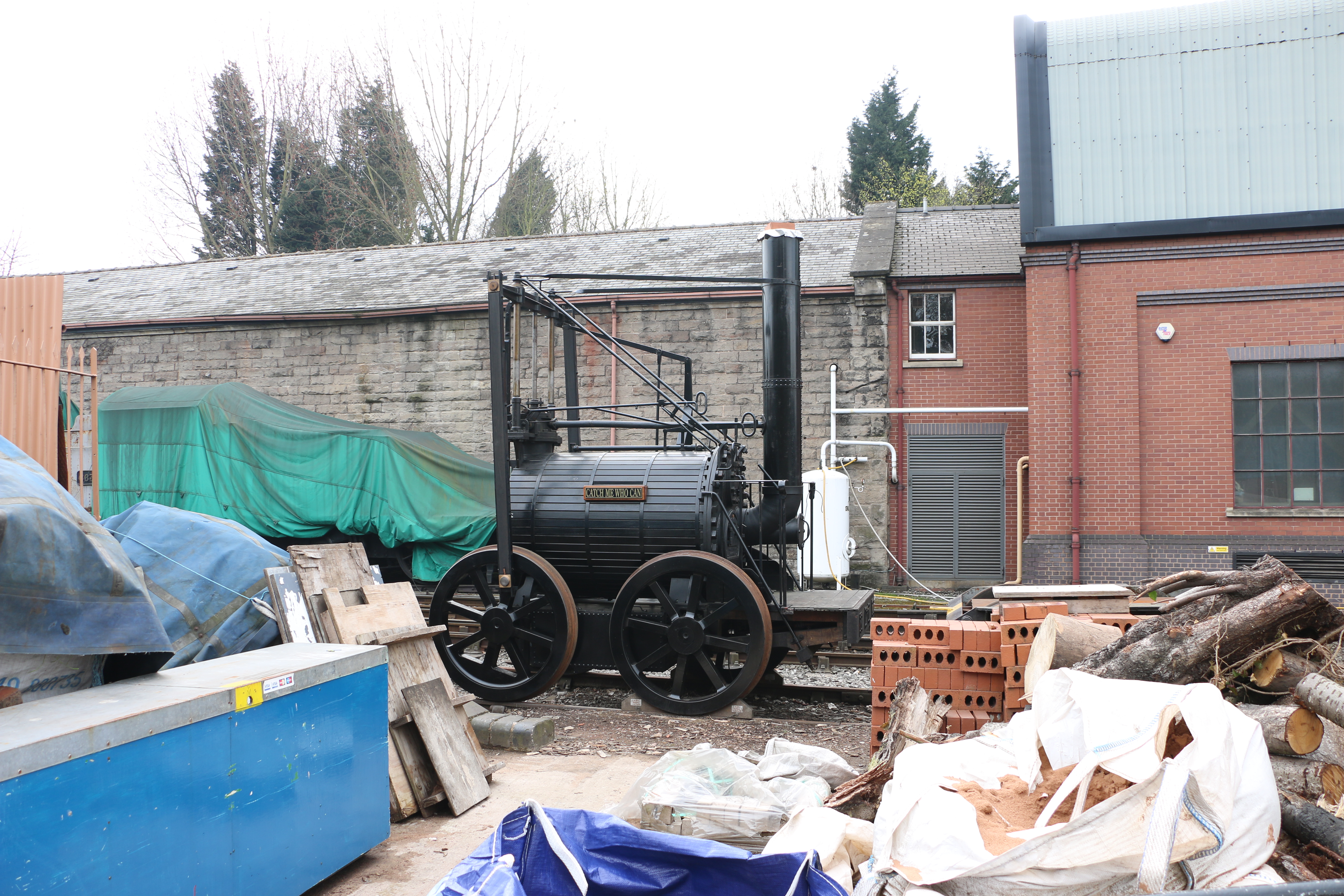
No original component survives. A working replica was completed in 2008 by the Trevithick 200 group at Telford to mark the bicentennial of the original demonstration. The replica has been periodically steamed for public demonstrations and is currently based at the Severn Valley Railway.
Design and development
By 1808 Trevithick's earlier railway experiments, Penydarren of 1804 and the Wylam engine of 1805, had shown that contemporary track was inadequate for steam locomotive weights. Rather than continue commercial railway development, Trevithick decided to use a steam locomotive as a public demonstration to attract investor interest.
The engine was designed by Trevithick and built by John Hazledine and John Urpeth Rastrick at Hazledine's foundry at Bridgnorth, Shropshire, in early 1808. The design was substantially different from the earlier engines, a vertical cylinder rather than horizontal, a more substantial boiler, and a tube-frame chassis. The engine was named "Catch Me Who Can", a popular phrase reflecting Trevithick's belief that no horse could outrun his locomotive.
Trevithick had a circular track laid in a fenced enclosure on Bloomsbury Fields, north of the New Road (now Euston Road), London, at a site corresponding to modern-day Euston Square. The track was approximately 25 m in radius. The engine was set in motion in summer 1808 with the public admitted at one shilling per ride, making this the first occasion on which fare-paying passengers were carried by steam locomotion of any kind.
Service and withdrawals
The Steam Circus operated for several weeks in the summer of 1808. Crowds were substantial; the demonstration was a popular attraction and was reported widely in the contemporary London press. The engine reportedly achieved speeds of around 12 mph on the circular track, fast enough to outrun horses, demonstrating Trevithick's claim.
The demonstration ended abruptly when a rail broke under the engine, derailing it. Trevithick discovered he could not afford to repair the track and had insufficient capital to continue the demonstration in a more permanent venue. He was disillusioned by the lack of investor interest the demonstration had generated despite the public crowds, engineers and capitalists who had attended were generally polite about the technical achievement but unwilling to invest in commercial railway development at the scale Trevithick proposed.
After the Steam Circus, Trevithick turned away from steam locomotive development entirely. He emigrated to South America in 1816 to work on Peruvian silver mining and never built another locomotive. His role in launching the steam railway era was widely overlooked at the time and only properly recognised by later generations.
Identification features
The engine had a single vertical cylinder mounted prominently on the rear of the boiler, a vertical orientation chosen for the demonstration role rather than for engineering optimisation. A single large flywheel ran on the right-hand side. The boiler was substantial and exposed. The whole engine was approximately 12 ft long. A small, lightly-built passenger carriage was attached, in which fare-paying passengers were carried.
Numbers and names
None (single demonstration locomotive)
Notable locomotives
- Only locomotive built; first to carry fare-paying passengers
Allocations and regions
- Steam Circus, Bloomsbury, London (1808)
Livery history
Preservation
No original component of Catch Me Who Can survives. The engine was apparently broken up sometime after 1808, possibly being converted to stationary use; the historical record after the Steam Circus is fragmentary.
A working replica was completed in 2008 by the Trevithick 200 group at Telford to mark the bicentennial of the original demonstration. The replica was built to original drawings and specifications and has been periodically steamed for public demonstrations. It is currently based at the Severn Valley Railway and at various other heritage venues for special events.